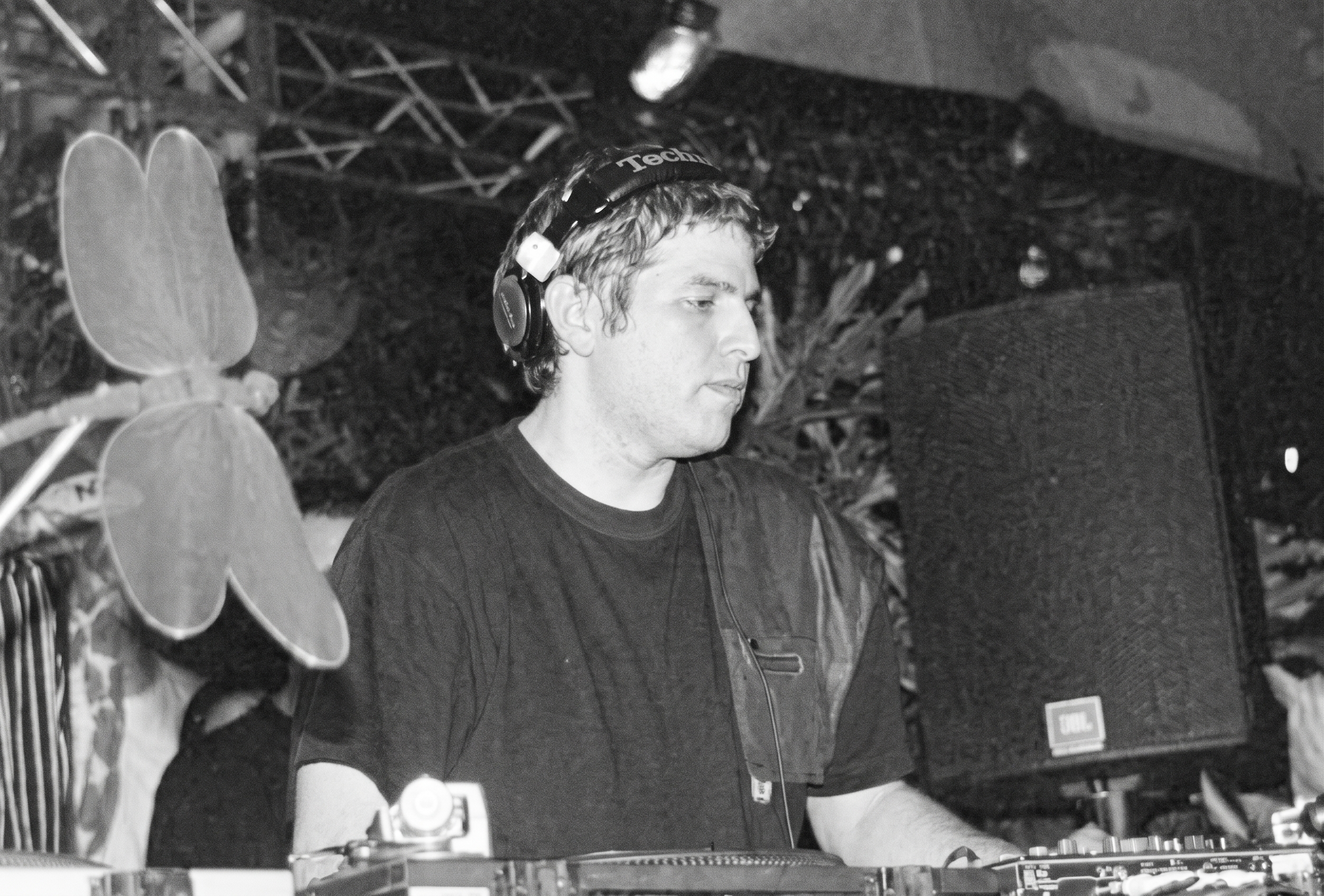
Before the festivals, before the wristbands and the apps, there was a flyer, a phone number and a warehouse somewhere off the 10. And somewhere in that warehouse, there was a good chance Doc Martin was playing.
Do you remember the flyers?
They came folded in half, passed hand to hand at Dr. Freecloud’s or tucked under a windshield wiper outside a club. Glossy, a little too colorful, with a phone number on the back and no address. You’d call the info line that night, write the map point on the back of your hand, and drive across the city with the windows down and a mixtape in the deck. Maybe Powertools was still going on Power 106, keeping you company on the freeway.

You didn’t know where you were going. That was the point.
And when you finally found it, a loading dock, a heavy door, a bass line you could feel in the parking lot, there was a chance the man behind the decks was a quiet guy from San Francisco named Martin Mendoza.
We called him Doc.
Before he was ours
Before Los Angeles claimed him, San Francisco made him.
Doc Martin started DJing in the summer of 1986, back when house music was still a rumor from Chicago and New York. His mother cut hair for Vidal Sassoon and Paul Mitchell and sang backup for local bands, including Paul Revere & the Raiders, he told Billboard. Music was always in the house.
House came to him through a very specific door. It “came through all the gay record stores in San Francisco,” he told AOL. That’s where this music was born and raised, in the rooms where people who weren’t welcome anywhere else made a place to dance. Doc never forgot that, and neither should we.
There wasn’t even enough house on vinyl to fill a whole night back then, so he mixed it with whatever felt right: Cabaret Voltaire, Marshall Jefferson, Italo disco. He played eight-hour sets at clubs like Flammable Liquid and Sunday Love, five or six nights a week. At 1015 Folsom, the city’s landmark club, he became part of the furniture. Its longtime owner, Ira Sandler, would later tell 48 Hills that Doc pushed harder than almost anyone to build a real house crowd in San Francisco.
By 1990 he felt like he’d done everything that city had to give. A few LA promoters talked him into coming south.
He thought he was moving for a job. He was really moving into the best years of all our lives.
Then the rave hit
“I moved to LA and then the rave hit,” he told 48 Hills. Then he said the rest of that story would take a whole novel.
If you were there, you already know the novel.
The LA he walked into was nothing like San Francisco. Up north, the scene lived in clubs. Down here, it lived in warehouses, with afterhours spots everywhere and crowds leaning toward hard European techno, he told the music site inn8. Doc brought something different in his record bag: the deep stuff from New York, Chicago and Detroit. He kept driving the 5 back and forth between the two cities, carrying records like letters between two families.
That’s what made Doc different. A lot of LA warehouses in those years were built on hard, fast techno, the kind of music that hits you in the chest from the first minute. Doc went the other way. He played deep: soulful house, funky tribal bass lines, acid that bubbled under everything. 48 Hills once summed up his sound as a mix of deep house, funky tribal bass and acid house, and early bios praised him for mixing the crowd as much as the records. He didn’t try to win you over in the first ten minutes. He took his time. He read the room, pulled it in slowly and built the night like a story. Somewhere around hour four you’d look up and realize you’d been traveling, and you had no idea how you got there.
That’s what “going deep” meant. LA learned it from people like him.
“The underground was really renegade in a lot of ways,” he told Billboard.
Renegade is the right word. Parties moved every weekend. Sometimes the cops found them before you did. The music didn’t stop until the sun came up. You’d lose your friends somewhere in the middle of the night and find them again at 5 or 6 in the morning, sitting on the curb in the first light, sharing a bottle of water, nobody wanting to be the first to say it was time to go home. Nobody had a phone to film it. All we have left is what we remember.
The first time Doc played a gig in LA, he turned around in the booth and found Nicolas Cage, Charlie Sheen and James Spader standing behind him, he told Billboard. That was LA too: Hollywood always trying to get in the door. But the heart of it was never the famous people in the booth. It was us on the floor.
Doc moved through all of it. He held a residency at the Metropolis and another at Glam Slam, the club Prince opened in LA in the ’90s. He went on the road as tour DJ for Deee-Lite when “Groove Is in the Heart” was playing everywhere. He shared bills with James Brown and Grace Jones, and later toured Australia with Basement Jaxx and Daft Punk. In 2003 he recorded fabric 10 for the legendary London club. He managed a record store, promoted parties, produced records and ran a label, sometimes all at the same time.
Then the big venues came, places like the Palladium, and the money came with them. The warehouses got harder to find. Then they got turned into lofts.
Sublevel
Some people left with the warehouses. Doc built a home.
Sublevel is the party, and later the label, he made with the singer and songwriter Lillia. He told Insomniac he first met her in 1990, at those early house clubs and raves, and that when she walked in, you knew it was going to be a great night. Thirty-some years later, she’s still beside him, and Sublevel is as much hers as his. The two of them started the Sublevel record label together. Her voice runs through his records: “For the Music” on Nervous, “Vajra” on Poker Flat, the Loveland EP with Joeski, and plenty more. When she sings live over his sets, they call it “Sublevel Live.” Doc builds the room. Lillia gives it a voice.
LA Weekly called Sublevel one of the first of LA’s roaming parties. At the very first one, Doc played for 13 hours. Thirteen. Think about where you were standing at hour twelve the last time you went out. Then think about him, still digging through the crate.
He even cut back on touring so he could keep his heart at home. “I wanted to do something for my community here in LA,” he told the paper.
That’s the part that gets me. He could have chased the main stage like everyone else. Instead he stayed in the room with us.
In February 2026, Sublevel threw a party in downtown LA for 25 years of the label and event series and for 40 years of Doc behind the decks. Radio Slave flew in from Berlin to play with him, 9 p.m. to 5 a.m. Some of the people on that floor were dancing to him before their kids were born.
Why “unsung”?
“Unsung” doesn’t mean unknown. It means history hasn’t given someone their due yet.
Inside the house world, Doc Martin is royalty. He’s played Panorama Bar, Rex Club in Paris, Space in Ibiza, Movement in Detroit, Coachella. LA Weekly has named him the city’s best house DJ and producer. When KCRW’s Jason Bentley interviewed him alongside Marques Wyatt, the station wrote that any “Mt. Rushmore of L.A. house DJs” would have both of their faces on it.
But walk through a festival crowd today and say his name, and most of those kids won’t know it. They’ll dance on a stage built on ground he helped clear, and never know who cleared it.
That’s what this series is for. Thee-O. Ron D Core. Swedish Egil on the radio. DJ Irene. Doc Martin. They kept the lights on in those years when nobody outside our little world was paying attention. We grew up inside the music they played. Some of us found ourselves there. Some of us lost people there, too, friends who didn’t make it to the other side of the ’90s. Every one of those nights is still in us somewhere.
Still playing
Most of those warehouses are gone now. The info lines are disconnected. The flyers are in shoeboxes, if you were smart enough to keep them. Dr. Freecloud’s is still open, one of the last places left where the old world still smells like vinyl. The friends you lost on the dancefloor and found again at sunrise have kids, mortgages and bad knees.
But Doc is still playing.
Starting this Saturday, November 14, he’s playing Sneak’s Birthday Beats on East Olympic Boulevard, on a bill with Derrick Carter, Mark Farina, DJ Sneak, Josh Wink and DJ Heather. If those names mean something to you, you already know what kind of night it’s going to be. On November 28 he’s in San Diego at Quartyard. And Sublevel is still going.
Go. Bring the friend you used to drive across the city with. Stand in the back if you have to. Close your eyes around hour six, when he goes deep.
For a few minutes, it’ll be 1993 again. You’ll be young, the night won’t be over, and nobody will be in a hurry to go home.
Electronic Dance Magazine Your Guide to EDM Since ’05
Follow Doc Martin: ra.co/dj/docmartin · soundcloud.com/sublevel-music · sublevelcalifornia.com