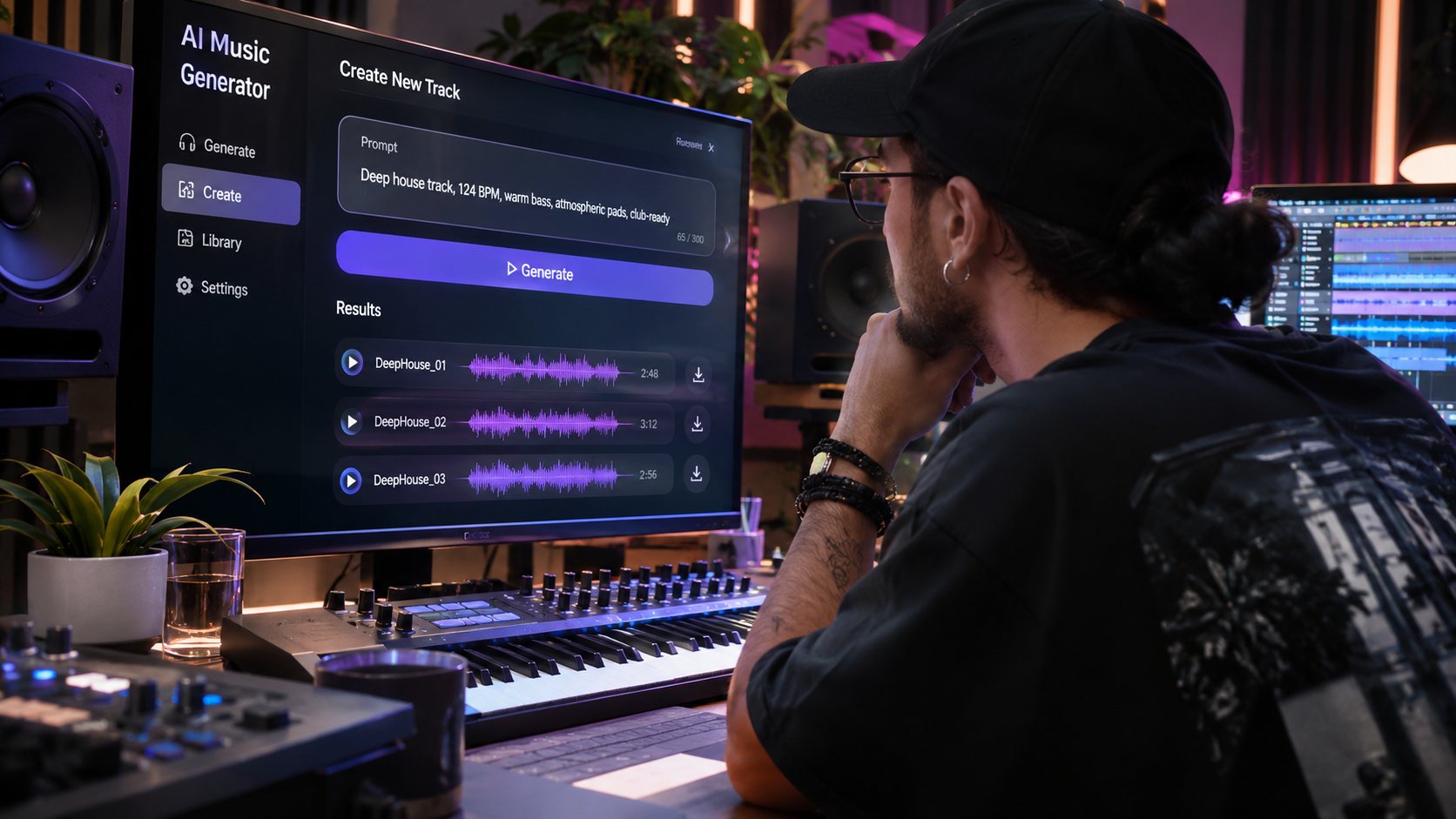
In 2024, this magazine predicted a future where humans and machines would make music side by side. In 2026, the dance music world answered back: not so fast.
In January 2024, Electronic Dance Magazine ran a piece called “The Rise of AI in Electronic Music Production: A Symphony of Algorithms and Beats.” It was hopeful. It said the future of electronic music would be a blend of human and machine-made melodies, “each enriching the other.”
Almost three years later, it’s worth checking in on how that went.
The short version: the machines showed up, all right. They showed up by the hundreds of thousands, every single day. And in 2026, the people who actually buy, play and love dance music started closing the door on them.
The flood
The numbers this year are hard to believe.
Deezer, the French streaming service that has tracked AI uploads more closely than anyone, said in late 2025 that around 50,000 AI-generated tracks were landing on its platform every day, about a third of all new music. By spring it was nearly 75,000 a day, 44% of uploads. In June it peaked at around 90,000 a day, more than half of everything uploaded.

Then came the study that made everyone stop scrolling. SubmitHub, the service artists use to pitch songs to playlists and blogs, ran more than a million July releases through its new AI detector, SH Labs. By that tool’s count, 38.5% of them had AI in them somewhere. (Keep in mind that’s one company’s detector making the call, not a census of every song on Earth, but the scale is hard to ignore.) Almost a quarter, 23.2%, were fully AI-generated. Another 15.3% were AI audio that a human had touched up afterward.
The part that stung most: when SubmitHub asked the artists behind the flagged tracks whether they’d used AI, 31% said no.
Here’s the strange twist. Almost nobody is listening to this stuff. Deezer says fully AI tracks make up only 1% to 3% of actual streams, and that much of the activity around them is tied to fraud: fake artists, fake plays, real royalty money. The flood isn’t really aimed at fans. It’s aimed at the payout system.
The line
Bandcamp moved first. On January 13, it banned music made “wholly or in substantial part” by AI and said it could remove anything suspected of being generated. It also made clear that using AI to imitate other artists or their styles was off-limits. For a lot of independent musicians, it was the first time a major platform had picked a side.
Others followed in their own ways. Deezer started labeling AI tracks, keeping them out of its recommendations and demonetizing up to 85% of AI streams. Tidal stopped paying royalties on fully AI-generated tracks in July. Spotify, which said it removed 75 million spam tracks in a single year, announced in August that it would put an “AI Persona” badge on certain artist profiles, with the rollout starting in September. Even the industry’s biggest organizations, including the RIAA, the Recording Academy and independent-label groups, teamed up on a shared labeling system that marks songs as fully AI or AI-assisted.
But for dance music, the moment that mattered came on August 12.
Beatport picks a side
Beatport is where DJs shop. It’s the record store of the digital era, the place where a track goes before it goes into somebody’s set. So when Beatport changed its rules, it changed them for the whole culture.
Under its new guidelines, fully or mostly AI-generated tracks are now stopped before they ever reach the store, and the rights holders are told why. Tracks that were made by humans with some help from AI are still allowed, but they get tagged, so DJs can see what they’re buying. To catch the fakes, Beatport expanded its partnership with Beatdapp, a company that started out fighting streaming fraud.
Beatport framed the decision around one idea: there’s a difference between a tool that assists human creation and a system that replaces it. Beatport, it said, is built on the first one.
The reason wasn’t complicated. Beatport asked its DJs. In its survey, 60% said they would not play AI-generated tracks in their sets. Among that group, 77% said the reason was a firm preference for supporting human creators. Only 8% said they were open to playing AI music, and another 13% said they’d consider it if artists and labels were fairly paid.

So no, not every DJ is against it. But the room has clearly made up its mind.
That’s the number that tells you something about this culture. A DJ isn’t just a playlist. A DJ is a person standing behind a table, putting their name and reputation on every record they choose. Crate-digging means something only if there’s a human on the other end of the crate.
The artists answer
Some artists aren’t waiting for platforms to decide for them.
In July, the dubstep duo BARELY ALIVE released a seven-track EP and called it, as plainly as possible, 100% NO AI. It’s a loud, joyful return to the brostep sound that made them, with features from PAV4N, the Ragga Twins and Tynan. Its message is right there in the title, and the duo described the project as music and artwork “handmade by humans, for humans.” A month later, they relaunched their label, KILLED IT!, to give the next wave of brostep producers a home.

Not everyone sees it the same way, and the other side has a real argument. It goes like this: dance music has never been afraid of machines. This whole culture was built on them. The Roland TB-303 was a failed bass machine until Chicago kids turned it into acid house. Sampling was called theft before it was called art. Drum machines were supposed to kill drummers. Synthesizers were “not real instruments.” Laptops were “not real DJing.” Every one of those fights ended the same way, with the new tool becoming part of the sound. Why should AI be any different?
It’s a fair question. The honest answer might be that it depends on what the machine is doing. A 303 still needed someone to turn the knobs. A drum machine still needed someone to program the groove. Generative AI is the first tool that can make the whole track while nobody is in the room.
Tyga used AI to generate the retro synths on his new album and compared the backlash to the early days of Auto-Tune. Timbaland has gone further, launching a company called Stage Zero and introducing an AI “artist” named TaTa. And legally, the ground is still moving: in July, a German court ruled against the AI music generator Suno in a copyright case brought by the rights society GEMA.
Where the line actually is
None of this is as clean as “human good, machine bad,” and it’s worth being honest about that.
Almost none of these policies punish a producer who uses AI to separate stems, clean up a mix or master a track. They’re aimed at fully generated songs and fake artists. But words like “substantial part” and “majority” are slippery. Who measures that? A detector? Detectors make mistakes, and that 31% of artists who denied using AI includes people who may be lying and people who may be telling the truth.
SubmitHub’s founder, Jason Grishkoff, put it simply: “I think the path forward for AI music is disclosure.” Tell people what they’re hearing, and let them decide.
Three years later
So was our 2024 article wrong?
Not completely. AI is in the studio now, and it isn’t leaving. Producers use it every day in small ways that nobody notices and nobody minds.
What our 2024 article missed was the distinction the industry ended up drawing. Look closely at the new rules, and almost none of them ban AI. They ban AI as the artist. AI as an instrument, something a producer reaches for the way they’d reach for a compressor or a sampler, is still welcome, as long as it’s labeled.
That’s the line. Not human versus machine, but who’s actually making the music. When the machines started making whole songs by the tens of thousands, a big part of the dance music world, the DJs, the fans, the stores that serve them, looked at the flood and decided they still wanted a person on the other end.
Maybe that’s the most dance-music answer possible. This culture was built by people in record stores and warehouses, trading tracks hand to hand, trusting each other’s taste. It was never about how much music exists. It was always about who made it, and who decided to play it for you.
In 2026, the dance floor decided it still wants to know.
Electronic Dance Magazine Your Guide to EDM Since ’05